Dirty Little Secrets - Silenced Voices
Exhibition Introduction by Dr Annabel Ahuriri-Driscoll
Associate Professor at Te Whare Wānanga o Waitaha / The University of Canterbury
Adoption is at once a practice, an intervention, a social institution, and an experience.
Adoption entails meanings relative to time, place, culture and position, produced and exchanged through language.
Narratives about adoption encompass values, beliefs, moral orientations and attitudes, which shape every facet of our experience as adopted people.
How we came to be adopted, how we should feel about being-adopted, how we should be, what we should do or not do...
Blank slates, chosen, special, grateful, lucky, content not to search, or if we must, searching to achieve resolution in one fell swoop, acknowledging but never preoccupied with being-adopted.
As well as what is narrated, there is much that is not. There are gaps and omissions, silences and denials. These too shape us.
The Adoption Act 1955 was designed to clean up and square away an undesirable situation. It constituted redemption for unwed mothers, illegitimate children and, in numerous cases, infertile couples.
Section 16 clause 2 subclause a. ‘As if born to’. Four words putting into effect the legal fiction that would forever change our futures. The erasing of whakapapa; erasing of our whānau; erasing who we were, who we might have been.
Adoption was a technology of assimilation that sought to whitewash our ‘dangerous difference’, and when the time came, played its part in furthering the colonial project.
Some 100,000 adoption orders have been granted under the Adoption Act since 1955, and despite the opening up of adoption practice in the 1980s, the legislation and its effects remain.
Equally troubling is our ongoing struggle for voice – the narrative labour is immense as we painstakingly fill in the gaps in our origin stories, repair the narrative and emotional ruptures, and reconstruct who we are, on our terms.
We narrate into the silences.
We narrate to counter the popular but simplistic adoption tropes.
With narrative we can be ourselves, we can reclaim, we can heal.
This is the socio-cultural historical backdrop to the exhibition ‘Dirty Little Secrets: Silenced Voices’, a showing of the work of twelve adoptee artists: Allison Beck, Ange Oliver, Caitlin Rose Donnelly, Christine Ford, Jillaine Lang, Katherine Morrison, Mary Curtis, Philippa Doyle, Sheryl Maree Boxall, Tracy Singer, Victoria Edin and William Remi.
As with any adopted people, their experiences differ and their stories illuminate these differences – of closed and open adoption, intra-racial and trans-racial adoption, tauiwi and Māori identities, experiences of removal and State care. However, they all share the same core experience – loss with gain, ‘unchosen’ in order to become ‘chosen’, and a lifetime of coming back to origins, to themselves. Their desire to say something about these experiences, has brought us here.
…We live in the telling.
…In this form we can exist in many places, in many minds at once – but these words cannot adequately convey the actual experience of our lives. These shapes and groups that you think of as words are just ghosts, the faint outline of a life, an approximation. Still, it is enough for you to glimpse the world of the other.
…Through stories, you can achieve the impossible and travel through time. Past, present, future – all able to be lived and felt by you. The lives you can live within a story are endless…
…perhaps you think you know our stories. Because our names are our story, they are us. They become part of the words that have been spoken about us, written about us, they bind us like the aka vine – their whispers encircle and define us. We have all found ourselves clothed in a character that wasn’t familiar – in skin that was pulled and stretched to fit another idea of us. It is a partial truth. Not ours, but theirs.
Perhaps a story can only be told in slivers; no one can perceive the whole, the truth. Because is it ever truly possible for anyone to understand the life of another completely? We will tell you our stories anyway…
Whiti Hereaka (2019, 24-8)
“Prologue.” In Pūrākau: Māori Myths Retold by Māori Writers, edited by Witi Ihimaera and Whiti Hereaka, 22-29. Auckland, New Zealand: Vintage/Penguin Random House New Zealand.
As well as showcasing adoptee experiences and stories, this exhibition continues the 40-year conversation seeking reform of the Adoption Act 1955.
There has been substantive legal discussion around the relevancy of the Act, including by the Ministry of Justice. In 1985 legal academic Iain Johnston noted that “the basic statutory concept was no longer appropriate for most situations”. In Puao-te-ata-tu, the 1988 Report of the Ministerial Advisory Committee on a Māori Perspective for the Department of Social Welfare, it was stated that closed adoption “is a totally alien concept, contrary to the laws of nature in Māori eyes”. And in 2000 the Law Commission found that the legal fiction was “a repugnant and unnecessary distortion of reality”.
Aotearoa New Zealand’s adoption legislation contravenes both the United Nations Declaration on the Rights of Indigenous Peoples, and, the United Nations Convention for the Rights of the Child, which grant, among other things, the right to cultural heritage and an ongoing connection with biological parents.
These are human rights that should be restored for all those adopted under the Act, and that would give adopted people true equality under the law.
This is now an intergenerational problem and the effects we carry also impact our children and their children. These injustices should not be left for another generation to address. The artists have picked up the mantle of earlier adoption activists to move the conversation on.
2026 marks 71 years since the Adoption Act was passed. There have been numerous attempts at reform over the past 40+ years, in which there have been:
Six formal reviews
Two select committees
Four cabinet committees
A draft bill plus several sponsored bills placed in the ballot
A Human Rights claim
Five reports to the UN Committee for the Rights of Children promising review
A Royal Commission
Several Waitangi Tribunal claims
And no less than 10 Ministers who have pledged their commitment to reform.
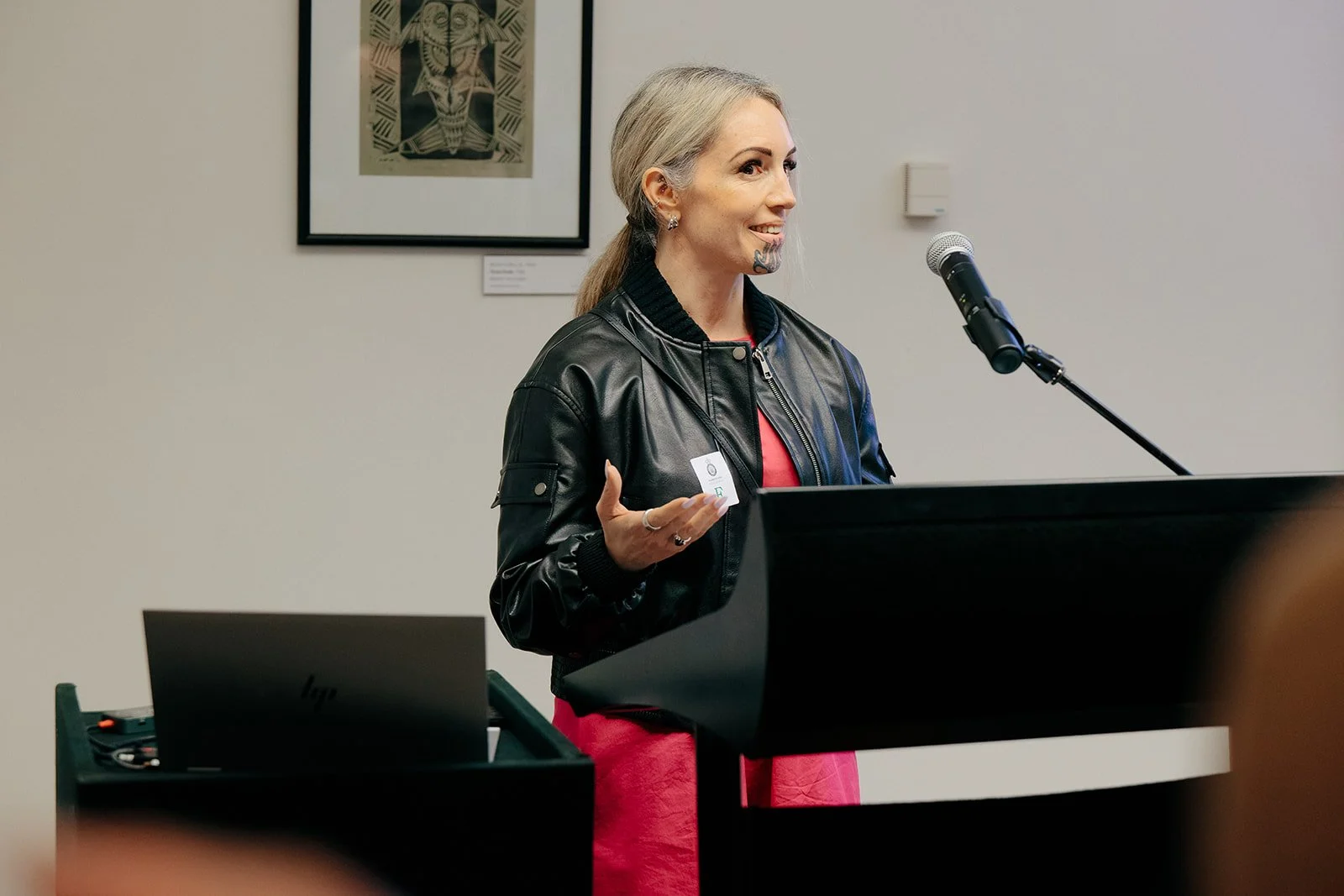
Annabel Ahuriri-Driscoll
Ngāti Porou, Ngāti Kauwhata, Rangitāne, Ngāti Kahungunu
Annabel was born in 1976 to a Māori father and Pākehā mother and subsequently placed in a Pākehā family via closed adoption. She met her whānau 19 years later and has been ‘in reunion’ ever since. Compelled to address some of her burning questions surrounding adoption, Annabel completed a PhD thesis on the experience of ‘being-Māori-and-adopted’ in 2020. She has drawn on her experiences and this work to advocate for adoption law reform and the recognition of adopted people and their rights, including through the Royal Commission for Abuse in Care, and the survivor-led redress design.
Annabel is currently an Associate Professor in Māori health and wellbeing at Te Whare Wānanga o Waitaha | the University of Canterbury.